

If you’ve ever laughed at a Spanish jokes, you already know the magic they carry. Spanish jokes blend clever wordplay, cultural warmth, and a sense of fun that crosses every border. Whether you’re a language learner hunting for bilingual humor or just someone who loves a good laugh, you’re in the right place.
This collection is packed with the best funny Spanish jokes and laugh-out-loud Spanish jokes, from quick Spanish one-liners to hilarious Spanish puns that will make your friends groan and grin at the same time. Get ready — your sides are about to hurt.
💡 Did You Know?
Spanish is the second most spoken native language in the world, with over 480 million native speakers. That means there are nearly half a billion people ready to laugh at a great Spanish joke. Humor in Spanish culture is deeply rooted in wordplay, family life, and food, which makes Spanish comedy some of the richest in the world.
Why Spanish Jokes Are So Popular
Spanish jokes have a way of bringing people together like nothing else. The Spanish language is naturally musical and expressive, which makes it perfect for comedy in Spanish and clever linguistic humor.
- Spanish has dozens of words with double meanings, making Spanish wordplay jokes almost too easy to write.
- The culture celebrates storytelling, so jokes feel natural and warm rather than forced.
- Bilingual jokes let people laugh in two languages at once, doubling the fun.
- Spanish-speaking communities span dozens of countries, each adding its own comic flavor.
- The rhythm of the language itself gives Spanish puns a built-in comedic punch.
- Funny Spanish phrases often sound musical even when they’re absurd, which is part of why Spanish jokes spread so fast online.
- Learning Spanish through jokes makes vocabulary stick far better than flashcards.
- Spanish humor tends to be inclusive and family-friendly, which makes it perfect for all ages.
- The warmth in Spanish culture means jokes often come with a hug attached.
- Popular Spanish jokes spread fast on social media because they translate across cultures.
- Even beginners can enjoy simple Spanish jokes without needing a dictionary.
- Spanish jokes work great as ice breakers in classrooms, parties, and offices.
In my personal experience, the moment I shared a spanish jokes collection at a dinner table, the whole room lit up. There’s something about Spanish humor that feels instantly welcoming and warm. It doesn’t matter if everyone speaks the language — laughter always translates perfectly.
Funny Spanish Jokes That’ll Make You Laugh
These are the all-around crowd-pleasers — the hilarious Spanish jokes that work every single time, no matter who you’re talking to.
- ¿Por qué el libro de matemáticas estaba triste? Porque tenía demasiados problemas. (Why was the math book sad? Because it had too many problems.)
- I told my Spanish friend I was cold and he said “¡Qué frío!” — and then laughed for five minutes straight.
- ¿Qué le dice un semáforo a otro? ¡No me mires, me estoy cambiando! (What does one traffic light say to another? Don’t look at me, I’m changing!)
- I asked my Spanish teacher for a funny joke in Spanish and she said “¡Tú!” — turns out “you” is the punchline.
- ¿Por qué los pájaros vuelan al sur en invierno? Porque caminar sería demasiado lejos. (Why do birds fly south in winter? Because walking would take too long.)
- My Spanish-speaking neighbor waves at me every morning and says “¡Buenos días!” — honestly, the best Spanish greeting joke I’ve ever been part of.
- ¿Qué hace una abeja en el gimnasio? ¡Zum-ba! (What does a bee do at the gym? Zumba!)
- I tried to write a Spanish joke but forgot the punchline — I guess you could say I lost my “español.”
- ¿Por qué el espantapájaros ganó un premio? Porque era sobresaliente en su campo. (Why did the scarecrow win an award? Because he was outstanding in his field.)
- A Spanish comedy show once made me cry laughing — Spanish jokes really do hit different on screen — then I realized I didn’t understand a word and was just copying everyone else.
- ¿Cómo se llama el campeón de buceo japonés? Tokofondo. (What’s the Japanese diving champion called? Tokofondo — “I sank to the bottom.”)
- These laugh-out-loud Spanish jokes are basically a cheat code for making friends anywhere in the world.
In my personal experience, sharing Spanish jokes with people who are just learning the language gives them a huge confidence boost. The moment someone laughs at a joke they barely understood, they feel like they’ve cracked a secret code. That feeling is priceless.
Best Jokes in Spanish for Language Learners
If you’re learning Spanish, these beginner-friendly Spanish jokes will help you practice while you laugh. Great jokes for Spanish students make vocabulary unforgettable.
- ¿Cómo se dice “computer” en español? “Computadora” — which sounds even more impressive when you say it fast.
- Learning Spanish vocabulary through jokes is the most fun homework you’ll ever do.
- ¿Sabes por qué los estudiantes de español siempre están felices? Porque cada día es un “¡Olé!” (Do you know why Spanish students are always happy? Because every day is an “Olé!”)
- My Spanish teacher told me I was an “estudiante estrella” — and I didn’t know if I should be proud or confused.
- ¿Qué le dijo el océano a la playa? Nada. (What did the ocean say to the beach? Nothing. — “Nada” means both “nothing” and “swim.”)
- Language learning jokes like this one prove that Spanish double meanings are basically cheat codes for comedy.
- ¿Por qué el estudiante comió su tarea? Porque el profesor le dijo que era un pedazo de torta. (Why did the student eat his homework? Because the teacher said it was a piece of cake.)
- I once conjugated “ir” perfectly in a sentence as a joke and accidentally impressed my whole class.
- ¿Cómo sabes si alguien habla español? No te preocupes, ellos te lo dirán. (How do you know if someone speaks Spanish? Don’t worry — they’ll tell you.)
- Easy Spanish jokes like this one work whether you’re fluent or still learning your ABCs in Español.
- ¿Por qué el libro de español fue al médico? Porque tenía demasiadas “conjugaciones.” (Why did the Spanish book go to the doctor? Because it had too many “conjugations.”)
- Sharing jokes to learn Spanish with your classmates makes every study session feel less like school and more like a comedy show.
In my personal experience, nothing made vocabulary stick faster than learning Spanish jokes by heart. I remembered “nada” forever after the ocean-beach punchline hit me. If you’re studying Spanish, jokes are your secret weapon.
Short Spanish Jokes with English Translation
Sometimes you need a quick hit of humor. These short Spanish jokes with translation deliver the laugh in under ten seconds.
- ¿Por qué el tomate se puso rojo? Porque vio a la ensalada sin ropa. (Why did the tomato turn red? Because it saw the salad undressing.)
- These translated Spanish jokes prove that some things are even funnier when you understand them twice.
- ¿Qué le dijo el 0 al 8? ¡Bonito cinturón! (What did the 0 say to the 8? Nice belt!) — a classic short Spanish pun.
- ¿Dónde estudian los reyes? En la Universidad. (Where do kings study? At the “Uni-versity” — “uni” means “one” in Latin, they’re number one.)
- ¿Qué hace una vaca cuando no tiene trabajo? ¡Pide trabajo de “vaca”ciones! (What does an unemployed cow do? It asks for a “cow”-cation — vacation!)
- Bilingual puns in Spanish like this one are double the trouble and double the fun.
- ¿Por qué el esqueleto no fue a la fiesta? Porque no tenía cuerpo para ir. (Why didn’t the skeleton go to the party? Because it had nobody to go with.)
- ¿Cuándo es 8+8=4? Cuando te equivocas dos veces. (When is 8+8=4? When you’re wrong twice.)
- These quick Spanish jokes are perfect for texting, captions, or just livening up a boring Monday.
- ¿Qué le dice un jardinero a otro? ¡Que tengas un buen “ramo” de suerte! (What does one gardener say to another? Have a great bouquet of luck!)
- ¿Por qué los matemáticos son buenos cocineros? Porque siempre saben las “recetas.” (Why are mathematicians good cooks? Because they always know the “recipes” — also means “prescriptions.”)
- Short Spanish humor quotes fit perfectly into Instagram captions and text messages without losing any of the laughs.
In my personal experience, short jokes are the ones people screenshot and send the most. I’ve had friends text me Spanish jokes and Spanish puns at midnight just because they finally “got” one hour later. That delayed laugh is worth everything.
Clean Spanish Jokes Everyone Will Enjoy
These clean Spanish jokes are safe for the whole family, the classroom, and even the office. No filter required.
- ¿Por qué el sol no fue a la escuela? Porque ya tenía miles de grados. (Why didn’t the sun go to school? Because it already had thousands of degrees.)
- Family-friendly Spanish jokes like this one work perfectly at dinner tables across the world.
- ¿Qué le dice una iguana a su hermana gemela? Somos iguanas. (What does an iguana say to its twin sister? We are iguanas — “iguanas” sounds like “igual” meaning “equal/same.”)
- ¿Por qué la luna no come? Porque está llena. (Why doesn’t the moon eat? Because it’s full.)
- These appropriate Spanish jokes for kids are clever enough for adults to enjoy and simple enough for kids to remember.
- ¿Cuál es el colmo de un electricista? Que su hijo se llame Luz. (What’s the ultimate coincidence for an electrician? His daughter is named “Luz” — meaning Light.)
- ¿Qué hace un pez cuando está aburrido? Nada. (What does a bored fish do? Nothing. / Swims. — “nada” again doing double duty.)
- Clean Spanish wordplay like this is why language teachers love using jokes in their classrooms.
- ¿Por qué el libro estaba abierto en el examen? Porque tenía que “abrirse paso.” (Why was the book open during the exam? Because it needed to “open up” — work its way through.)
- ¿Qué le dice un techo a otro techo? Nada, los techos no hablan, pero los tejados sí que tienen tejas. (What does one roof say to another? Nothing, roofs don’t talk — but tiled roofs do have “tales.”)
- Safe Spanish jokes are the ones you can share in any setting without worrying about who’s in the room.
- ¿Por qué los fantasmas no mienten? Porque se les ve a través. (Why don’t ghosts lie? Because you can see right through them.)
In my personal experience, clean jokes get shared the most in group chats. People feel comfortable sending them to parents, kids, coworkers, and everyone in between. A good set of Spanish jokes travels faster than any punchline that needs a warning label.
Easy Spanish Jokes for Beginners
New to the language? These easy Spanish jokes for beginners use simple vocabulary so you can understand and even tell them yourself.
- ¿Cómo se llama un perro sin patas? No importa cómo lo llames, no va a venir. (What do you call a dog with no legs? It doesn’t matter what you call it — it won’t come.)
- Simple Spanish jokes like this work with just a handful of vocabulary words and deliver a huge laugh.
- ¿Qué animal tiene más letras? El gato — tiene cuatro letras y cuatro patas. (Which animal has the most letters? The cat — “gato” has four letters and four paws.)
- ¿Por qué el gato se cayó del árbol? Porque tenía sueño y no vio la rama. (Why did the cat fall out of the tree? Because it was sleepy and missed the branch.)
- These beginner Spanish puns are a great way to practice reading comprehension while laughing.
- ¿Qué hace una abeja rubia? Zuuumba. (What does a blonde bee do? Zooomba — just buzzes louder.)
- ¿Cuántos años tiene el agua? No sé, pero el río tiene muchas. (How old is water? I don’t know, but the river has many years — “ríos” also means “I laugh.”)
- Easy jokes in Spanish help beginners build confidence to actually use the language in real conversations.
- ¿Por qué el piano fue al médico? Porque le dolían las teclas. (Why did the piano go to the doctor? Because its keys were hurting.)
- ¿Qué le dijo el papel a la pluma? “Me tienes en blanco.” (What did the paper say to the pen? “You’ve left me blank.”)
- Learning Spanish is easier when you start with fun Spanish phrases for beginners wrapped inside a great joke.
- ¿Por qué el futbolista llevaba encendedor? Porque perdió sus fósforos. (Why did the soccer player bring a lighter? Because he lost his “matches” — also means “matchsticks.”)
In my personal experience, the best way to get someone hooked on learning Spanish is to make them laugh first. Once a beginner gets a spanish jokes reference — really gets it — they’re motivated in a way no textbook can replicate. Start with easy jokes and watch the confidence grow.
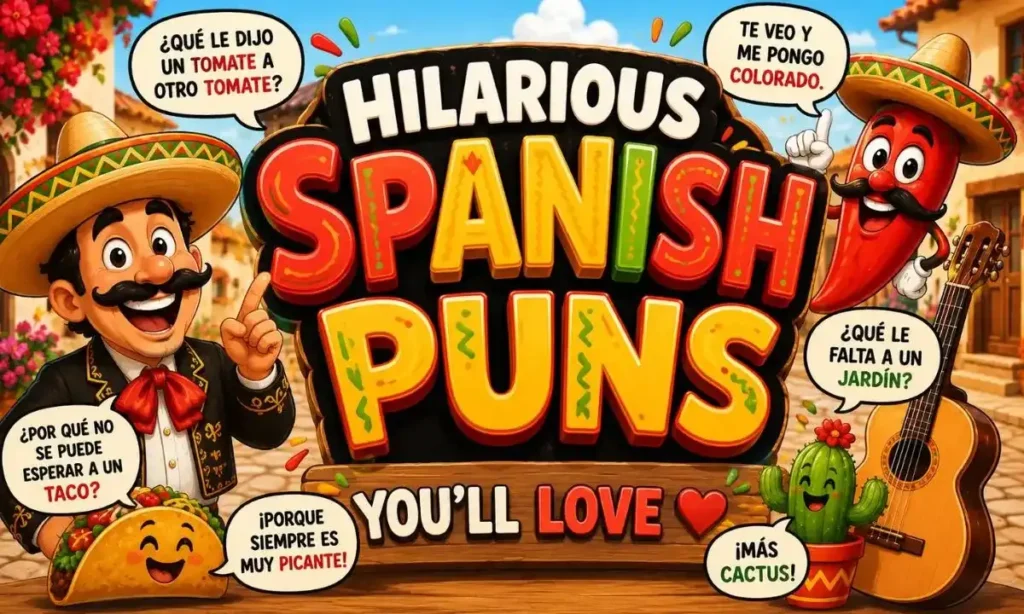
Hilarious Spanish Puns You’ll Love
Puns are the royalty of Spanish wordplay, and these hilarious Spanish puns are fit for a crown. If you love puns, you’re going to want to bookmark this section.
- ¿Por qué el espejo fue al psicólogo? Porque se veía muy reflejado en sus problemas. (Why did the mirror go to the therapist? Because it kept reflecting on its problems.)
- These Spanish language puns prove that wordplay sounds just as good — if not better — in Spanish.
- ¿Qué le dice el mar al barco? Nada. (What does the sea say to the ship? Nothing. / Swim. — “nada” strikes again.)
- ¿Por qué el reloj fue al dentista? Porque le dolía el minutero. (Why did the clock go to the dentist? Because its minute hand was hurting — “minuto” sounds like a tooth problem waiting to happen.)
- Clever Spanish puns like these are the reason bilingual people always seem to be laughing at something others can’t quite catch.
- ¿Qué le dijo el semáforo verde al rojo? ¡No cambies! (What did the green traffic light say to the red one? Don’t change!)
- ¿Por qué el biólogo rompió con su novia? Porque encontró otra. (Why did the biologist break up with his girlfriend? Because he found another “cell” — “otra” can sound like “otra célula.”)
- These funny Spanish language jokes are the kind that make you groan first and laugh two seconds later.
- ¿Qué hace un dinosaurio con un libro? Tira-no-saurus Rex. (What does a dinosaur do with a book? Tyranno-saurus Rips — a Spanish animal pun layered inside a dinosaur name.)
- ¿Por qué el pollo cruzó la carretera dos veces? Porque era un pollo de ida y vuelta. (Why did the chicken cross the road twice? Because it was a round-trip chicken.)
- Spanish humor puns remind us that language is a playground, and fluent speakers get the best equipment.
- ¿Qué hace un pez cuando está contento? Nada, pero con una sonrisa. (What does a happy fish do? Nothing — but with a smile.)
In my personal experience, Spanish puns hit differently when you understand both languages at once. There’s a split second where your brain translates and then — boom — you burst out laughing. That’s what great Spanish jokes built on bilingual wordplay feel like — nothing else can replicate it.
Clever Spanish One-Liner Jokes
For maximum impact in minimum words, these clever Spanish one-liners are sharp, witty, and impossible to forget.
- “No soy indispensable… soy imprescindible.” — The difference? One makes you feel needed, the other makes you feel legendary.
- The best Spanish one-liner jokes land like a punch and leave you smiling for the rest of the day.
- ¿Sabes qué es lo más difícil de aprender español? Las “excepciones a la regla.” (The hardest thing about learning Spanish? The exceptions to every rule — and there are many.)
- “Soy tan puntual que llego tarde a propósito para no parecer obsesionado.” (I’m so punctual I arrive late on purpose so I don’t seem obsessed.)
- Witty Spanish jokes like this one work because Spanish-speakers will nod along knowing exactly who they know like that.
- “Si la vida te da limones, haz limonada. Si te da tequila… ya sabes.” (If life gives you lemons, make lemonade. If it gives you tequila, you already know what to do.)
- ¿Por qué los españoles nunca están solos? Porque siempre tienen un “amigo” cerca. (Why are Spanish speakers never alone? Because they always have a “friend” nearby — friendship is sacred in Spanish culture.)
- These short, funny Spanish phrases — the best kind of Spanish jokes — are perfect for captions, cards, or just making someone’s day.
- “Hablar español es como cantar — cuando lo haces bien, la gente aplaude; cuando lo haces mal, todavía aplaude pero por educación.” (Speaking Spanish is like singing — do it well and people clap; do it badly and they still clap out of politeness.)
- ¿Cuál es el idioma más divertido del mundo? El español, porque tiene ñ — y la ñ siempre hace que la gente sonría. (The funniest language in the world? Spanish — because it has ñ, and ñ always makes people smile.)
- One-liner Spanish humor is the art of packing an entire story into a single sentence and still landing the joke — and if dry wit is your style, our drier than jokes collection is right up your alley.
- “Mi español no es perfecto pero mis chistes sí.” (My Spanish isn’t perfect — but my jokes are.) — The truest thing ever said.
In my personal experience, one-liners are the jokes that non-Spanish speakers ask me to repeat the most. There’s something about the compact power of a single clever line that makes people want to learn just enough Spanish to tell Spanish jokes themselves.
Funny Spanish Dad Jokes
Dad jokes are a universal language, but Spanish dad jokes have extra charm. These papá jokes in Spanish are perfectly groan-worthy.
- ¿Qué hace papá cuando llueve? Se moja. (What does dad do when it rains? He gets wet.) — Classic dad energy.
- Spanish father jokes prove that dads are naturally funny in every culture and every language.
- ¿Cómo llamas a un padre que siempre tiene hambre? ¡Papá frita! (What do you call a dad who’s always hungry? “Papá frita” — French fry dad!)
- ¿Por qué el papá astronauta fue al espacio? Porque quería estar entre las estrellas — igual que sus chistes. (Why did the astronaut dad go to space? Because he wanted to be among the stars — just like his jokes.)
- These cheesy Spanish dad jokes remind us that the dad joke gene is clearly part of universal human DNA.
- ¿Qué le dijo el papá taco al hijo taco? “No te dobles ante la presión.” (What did the papa taco say to the baby taco? Don’t fold under pressure.)
- ¿Por qué el papá computadora tiene tantos hijos? Porque no usó protección de pantalla. (Why did the computer dad have so many kids? Because he didn’t use screen protection.)
- Funny Spanish papa jokes land even harder when the whole family is at the table for Sunday dinner.
- ¿Cómo llamas a un papá que toca la guitarra mal? ¡Un papá-rrazo! (What do you call a dad who plays guitar badly? A “papá-rrazo” — like a paparazzo chasing bad notes.)
- ¿Por qué el papá siempre tiene razón? Porque si no, ya no es papá — es jefe. (Why is dad always right? Because if he weren’t, he’d just be “boss.”)
- These groan-worthy Spanish jokes are guaranteed to make every kid at the table roll their eyes and smile.
- ¿Qué tiene en común un papá con una pizza? Ambos se ponen mejor con el tiempo. (What does a dad have in common with a pizza? Both get better with age.)
In my personal experience, Spanish dad jokes are the glue of family gatherings. My own papá would tell the same three spanish jokes every Sunday dinner, and somehow they kept getting funnier. There’s real warmth in that repetition — it’s love in joke form.
Knock-Knock Spanish Jokes for Kids
These knock-knock Spanish jokes are simple, fun, and perfect for little ones learning Spanish or just looking for a giggle.
- Toc toc. ¿Quién es? Ana. Ana ¿quién? Ana-liza bien la situación antes de responder. (Knock knock. Who’s there? Ana. Ana who? Ana-lyze the situation before you answer!)
- Knock-knock jokes in Spanish are the best way to get kids excited about learning a new language.
- Toc toc. ¿Quién es? Vaca. Vaca ¿quién? Vaca-ciones — ¡ya llegó el verano! (Knock knock. Who’s there? Cow. Cow who? Cow-cation — summer is here!)
- Toc toc. ¿Quién es? Hugo. Hugo ¿quién? Hugo-t a laugh out of you! (Toc toc. ¿Quién es? Hugo. Hugo ¿quién? ¡Hugo reír!)
- These funny Spanish knock-knock jokes make Spanish class feel more like comedy hour and less like grammar drills.
- Toc toc. ¿Quién es? Ema. Ema ¿quién? Ema-gínate no reírte con esto. (Knock knock. Who’s there? Ema. Ema who? Imagine not laughing at this.)
- Toc toc. ¿Quién es? Pepe. Pepe ¿quién? Pepe-pino — ¡me encanta el pepino! (Knock knock. Who’s there? Pepe. Pepe who? Pe-pickle — I love pickles! — a perfect fit for anyone who loves food-themed wordplay.)
- Spanish jokes for children build vocabulary, encourage listening, and most importantly — make learning feel fun.
- Toc toc. ¿Quién es? Arturo. Arturo ¿quién? Arturo-llando de la risa. (Knock knock. Who’s there? Arturo. Arturo who? I’m rolling with laughter!)
- Toc toc. ¿Quién es? Isabel. Isabel ¿quién? Isabel necesaria en una bicicleta. (Knock knock. Who’s there? Isabel. Isabel who? Is a bell necessary on a bicycle?)
- These Spanish knock-knock jokes for kids work just as well in the backseat of a car as they do in a classroom.
- Toc toc. ¿Quién es? Luz. Luz ¿quién? Luz apagué — ¿no viste nada? (Knock knock. Who’s there? Luz. Luz who? I turned out the lights — didn’t you notice?)
In my personal experience, kids who learn knock-knock jokes in Spanish end up teaching them to their parents. There’s something magical about a child correcting an adult’s Spanish pronunciation through laughter. These Spanish jokes are a gateway to a whole new language love.
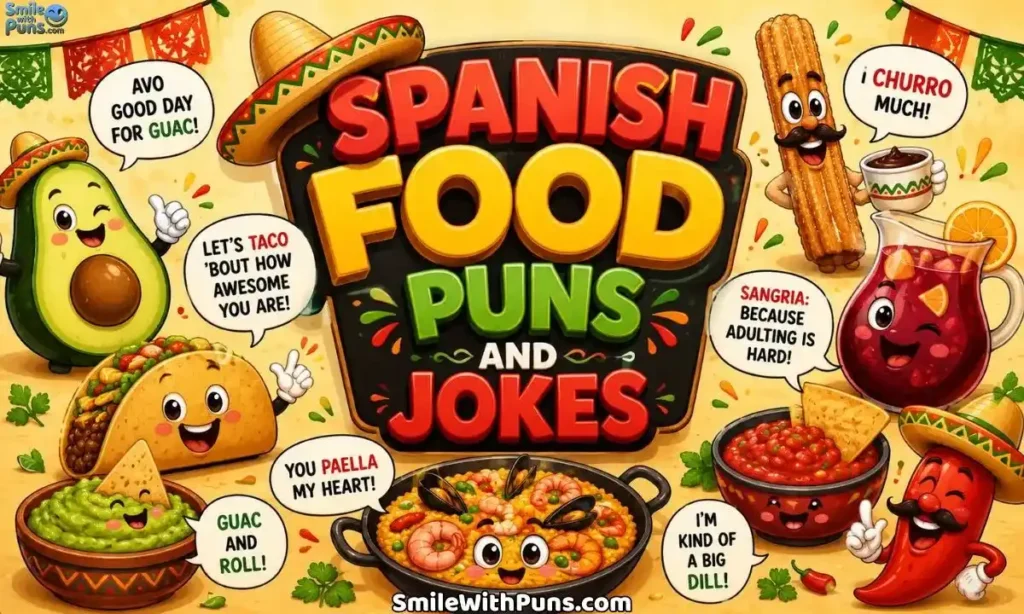
Spanish Food Puns and Jokes
Food and laughter go hand in hand in Spanish culture. These Spanish food jokes and food puns in Spanish are as satisfying as the real thing.
- ¿Por qué la tortilla nunca está sola? Porque siempre tiene alguien que la da la vuelta. (Why is the tortilla never alone? Because someone always flips it over.)
- Spanish cuisine jokes are some of the tastiest Spanish jokes out there, celebrating the incredible food culture that makes Spanish-speaking countries legendary.
- ¿Qué le dijo el arroz al frijol? “Juntos hacemos un gran equipo.” (What did the rice say to the bean? “Together we make a great team.”) — a Spanish food pun that hits close to home.
- ¿Por qué el taco fue al psicólogo? Porque se sentía “relleno” de problemas. (Why did the taco go to therapy? Because it felt “stuffed” with problems.)
- These funny food jokes in Spanish are perfect for anyone who bonds over cooking, eating, or just talking about food.
- ¿Cómo llamas a un burrito filosófico? Un burri-to que piensa mucho. (What do you call a philosophical burrito? One that thinks too much — a “burri-thinker.”)
- ¿Qué hace la salsa cuando está aburrida? ¡Se pone picante! (What does salsa do when it’s bored? It gets spicy!)
- Spanish cooking humor belongs in every kitchen and on every dinner table because food and laughter are the best combination — and if you love spicy humor, our chili puns will turn up the heat.
- ¿Por qué el gazpacho es tan popular en verano? Porque es la sopa que no necesita calentarse para calentar tu corazón. (Why is gazpacho so popular in summer? Because it’s the soup that doesn’t need heat to warm your heart.)
- ¿Qué le dijo el pan al jamón? “Juntos somos un bocadillo perfecto.” (What did the bread say to the ham? “Together we’re the perfect sandwich.”)
- These hilarious Spanish food puns prove that even a meal can become material for a great joke.
- ¿Por qué el queso manchego está siempre contento? Porque viene de La Mancha — tierra de sueños. (Why is manchego cheese always happy? Because it comes from La Mancha — the land of dreams.)
In my personal experience, the best Spanish food jokes come out at the dinner table, right after someone takes the first bite. There’s a joy in connecting humor to something as universal as eating — it makes the spanish jokes and the meal both taste better.
Funny Spanish Animal Jokes
Animals and Spanish animal humor make a perfect pair. These funny animal jokes in Spanish are wild, warm, and wonderfully silly.
- ¿Qué le dijo el perro al hueso? “Eres lo que me mueve.” (What did the dog say to the bone? “You’re what moves me.”) — pure Spanish dog humor.
- Spanish animal jokes are especially loved by kids and adults who speak the language of laughter fluently — if you enjoy these, our bird puns collection will have you chirping with joy.
- ¿Por qué el gato siempre gana en el póker? Porque nunca muestra sus garras. (Why does the cat always win at poker? Because it never shows its claws.)
- ¿Qué le dice un pez a otro? “¡Nada, nada y al final del río, morenada!” (What does one fish say to another? “Swim, swim — and at the end of the river, nothing!”) — a triple pun on “nada.”
- These funny Spanish jokes about animals work because animals have the same problems in every language.
- ¿Por qué el elefante usa maleta? Porque tiene demasiado equipaje emocional. (Why does the elephant use a suitcase? Because it has too much emotional baggage.)
- ¿Qué hace una vaca española en Halloween? ¡Moooo-stros! (What does a Spanish cow do on Halloween? Moooo-sters!)
- Animal puns in Spanish feel extra funny because you get the animal reference and the language twist at the same time.
- ¿Por qué el loro repite todo? Porque es el único que sabe escuchar de verdad. (Why does the parrot repeat everything? Because it’s the only one who truly listens.)
- ¿Qué le dijo el caracol al caballo? “¡Lento pero seguro!” (What did the snail say to the horse? “Slow but steady!”)
- These Spanish nature and animal jokes — among the warmest Spanish jokes — are as fun to tell as they are to hear — and they work in both languages.
- ¿Por qué la araña es tan buena diseñadora? Porque siempre teje algo increíble. (Why is the spider such a great designer? Because it always weaves something incredible.)
In my personal experience, animal jokes break down every barrier. I’ve watched people who don’t share a single word of common language laugh together at a mime of a cat joke. Spanish jokes about animals are universal in the best possible way.
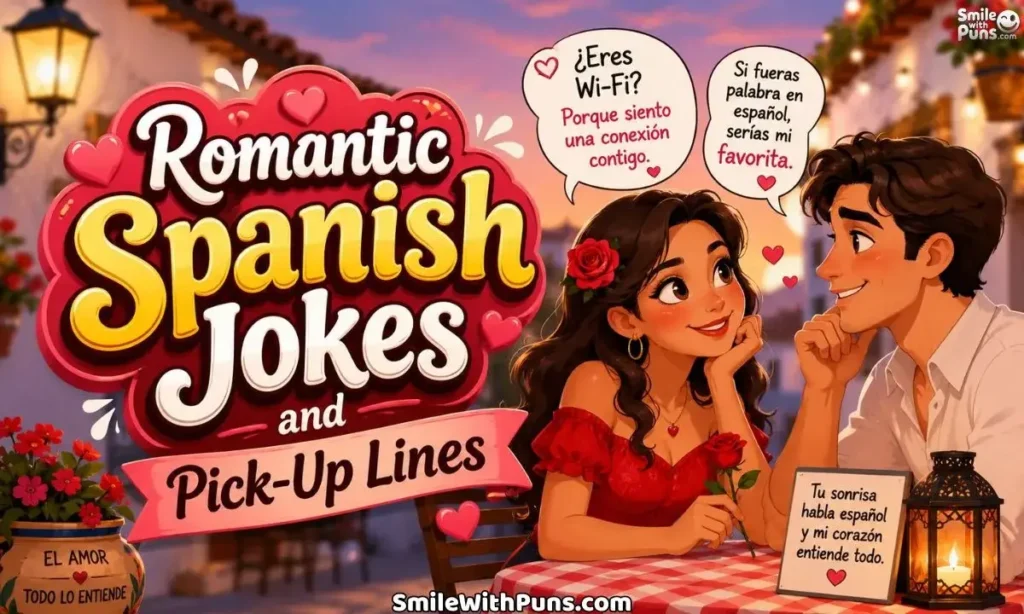
Romantic Spanish Jokes and Pick-Up Lines
Ready to turn up the charm? These romantic Spanish jokes and Spanish pick-up lines are flirty, funny, and just cheesy enough to work.
- ¿Eres de España? Porque eres “es-pañol” — the most beautiful language I’ve ever heard. (Are you from Spain? Because you’re “es-pain-ful” — too good to look at.)
- Funny Spanish flirting lines work because they combine confidence, culture, and just the right amount of silliness — for even more date-night material, check out these jokes to tell your boyfriend.
- “Si fueras una estrella, serías la del norte — porque siempre te busco.” (If you were a star, you’d be the North Star — because I always look for you.)
- ¿Eres un mapa? Porque me pierdo en tus ojos. (Are you a map? Because I get lost in your eyes.)
- These romantic jokes in Spanish are the kind that make people swoon and groan at the same time — the perfect combo.
- “No soy fotógrafo, pero me imagino que tú y yo podríamos hacer algo muy bonito juntos.” (I’m not a photographer, but I can picture us together.)
- ¿Eres una biblioteca? Porque me encanta revisarte. (Are you a library? Because I love checking you out.)
- Spanish love jokes are best delivered slowly, with eye contact, and with a half-smile that says “I know exactly what I just said.”
- “¿Crees en el amor a primera vista, o tengo que pasar otra vez?” (Do you believe in love at first sight, or should I walk by again?)
- ¿Te duele? ¿Que qué? Haberte caído del cielo. (Does it hurt? What? Falling from heaven.)
- These flirty Spanish one-liners — some of the most charming Spanish jokes around — prove that the most romantic language in the world knows how to laugh too.
- “Eres como el café — caliente, imprescindible, y me alegras las mañanas.” (You’re like coffee — hot, essential, and you brighten my mornings.)
In my personal experience, a well-timed Spanish pick-up line delivered with a smile is almost impossible to resist. Even if the other person groans, they’re already laughing — and that’s halfway to winning them over — Spanish jokes with heart always work.
Funny Classroom Spanish Jokes
These funny Spanish classroom jokes are made for teachers, students, and anyone who has ever survived conjugating verbs. Spanish teachers, this section is for you.
- ¿Por qué el estudiante de español siempre está confundido? Porque hay “ser” y “estar” — y nadie le explicó la diferencia todavía. (Why is the Spanish student always confused? Because there’s “ser” and “estar” — and nobody explained the difference yet.)
- Spanish classroom humor makes grammar lessons stick better than any worksheet ever could.
- ¿Qué dice el alumno cuando no sabe la respuesta? “¿Cómo se dice ‘I have no idea’ en español?” (What does the student say when they don’t know the answer? “How do you say ‘I have no idea’ in Spanish?”)
- ¿Por qué el examen de español fue al hospital? Porque nadie lo pasó. (Why did the Spanish exam go to the hospital? Because nobody passed it.)
- These Spanish teacher jokes are appreciated most by the educators who have graded one too many verb conjugation tests.
- ¿Qué le dice el subjuntivo al indicativo? “Ojalá me entendieras.” (What does the subjunctive say to the indicative? “I wish you understood me.”)
- ¿Por qué el alumno usó tiempo pasado en todo? Porque el futuro le daba miedo. (Why did the student use past tense for everything? Because the future scared him.)
- Funny Spanish grammar jokes are proof that even the most frustrating parts of language learning can become comedy gold.
- ¿Qué tienen en común un maestro de español y un mago? Ambos hacen que lo imposible parezca posible. (What do a Spanish teacher and a magician have in common? They both make the impossible seem possible.)
- ¿Por qué el examen de vocabulario estaba nervioso? Porque sabía que nadie lo había estudiado. (Why was the vocabulary test nervous? Because it knew nobody had studied.)
- These hilarious school jokes in Spanish are perfect for the last five minutes of class when everyone needs a laugh.
- ¿Qué hace el acento en español? Cambia todo el significado — como la diferencia entre “papa” (potato) y “papá” (dad). (What does the accent mark do in Spanish? It changes everything — like the difference between potato and dad.)
In my personal experience, the best Spanish class I ever attended was the one where the teacher started with a joke. It lowered the pressure, opened the room, and made everyone willing to try — even at the risk of making a mistake. Spanish jokes and laughter are the best classroom environment.
Mexican Spanish Jokes and Cultural Humor
Mexican Spanish jokes are rich with culture, tradition, and a warmth that’s uniquely Mexican. These celebrate the humor of one of the world’s most vibrant cultures.
- ¿Por qué los mexicanos son tan buenos cocineros? Porque siempre le ponen corazón a todo. (Why are Mexicans such great cooks? Because they put heart into everything.)
- Mexican humor blends pride, family, food, and a love of life that shows up beautifully in its jokes.
- ¿Qué hace un mexicano cuando tiene frío? Se pone otro suéter encima del que ya tiene. (What does a Mexican do when cold? Puts another sweater over the one already on.)
- ¿Por qué el chile en nogada es el platillo más dramático? Porque tiene verde, blanco y rojo — siempre haciendo su entrada. (Why is chile en nogada the most dramatic dish? Because it comes in green, white, and red — always making an entrance.)
- These Latin American jokes celebrate culture through comedy, which is the kindest form of pride.
- ¿Cómo sabe un mexicano que ya llegó al trabajo? Porque su mamá ya le mandó un mensaje preguntando si llegó bien. (How does a Mexican know he arrived at work? Because his mom already texted asking if he got there safely.)
- ¿Por qué las telenovelas mexicanas son tan largas? Porque cada “fin” tiene otro “comienzo.” (Why are Mexican telenovelas so long? Because every “ending” has another “beginning.”)
- Cultural Spanish comedy like this comes from a place of genuine love for tradition and community.
- ¿Qué es lo más rápido en México? El rumor que tu mamá ya sabe lo que hiciste. (What’s the fastest thing in Mexico? The rumor that your mom already knows what you did.)
- ¿Por qué el mariachi nunca llega tarde? Porque llega cuando debe llegar — y eso es perfecto. (Why is the mariachi never late? Because it arrives when it’s supposed to — and that’s perfect.)
- Mexican Spanish humor reminds us that the best jokes come from the heart of a culture that never takes itself too seriously.
- ¿Qué hace un mexicano con su abuela en Navidad? Le da un abrazo de tres minutos mínimo. (What does a Mexican do with his grandmother at Christmas? Gives her at least a three-minute hug.)
In my personal experience, Mexican humor taught me that jokes are never just about being funny — they’re about being seen. The best spanish jokes from Mexico carry real love for family, food, and the small moments that make life beautiful.
Funny Spanish Holiday and Christmas Jokes
Spanish Christmas jokes and holiday humor in Spanish make the season even merrier. These are perfect for holiday cards, parties, and family gatherings.
- ¿Qué le dice Papá Noel a los renos? “¡Vamos, que no tenemos todo el año!” (What does Santa say to the reindeer? “Let’s go — we don’t have all year!”)
- Christmas jokes in Spanish bring extra warmth to a season that’s already full of joy.
- ¿Por qué los Reyes Magos llegaron tarde? Porque siguieron las estrella equivocada en Google Maps. (Why did the Three Kings arrive late? They followed the wrong star on Google Maps.)
- ¿Qué pide un niño en España por Navidad? Los Reyes Magos — y que sus padres no se enteren de lo que pidió. (What does a Spanish child ask for at Christmas? The Three Kings — and that his parents don’t find out what he asked for.)
- These holiday Spanish puns are perfect for navidad cards and festive messages to friends and family.
- ¿Por qué el árbol de Navidad fue al psicólogo? Porque estaba muy “cargado.” (Why did the Christmas tree go to therapy? Because it was too “loaded” — with decorations and problems.)
- ¿Qué hace un turrón cuando está triste? Se pone duro. (What does nougat do when it’s sad? It hardens up. — turrón is a traditional Spanish Christmas candy.)
- Funny holiday jokes in Spanish travel perfectly in group chats during December and make every family thread a little more fun.
- ¿Por qué la Nochebuena es la noche más especial? Porque todos fingen que se llevan bien por 24 horas. (Why is Christmas Eve the most special night? Because everyone pretends to get along for 24 hours.)
- ¿Qué le dice un muérdago a otro? “¡Nos vemos en Navidad para dar trabajo a los tímidos!” (What does one mistletoe say to another? “See you at Christmas to give the shy ones something to do!”)
- These Spanish New Year jokes and holiday quips bring the perfect light touch to the most festive time of year.
- ¿Por qué Papá Noel habla español? Porque tiene que llegar a toda Latinoamérica en una noche — y es más rápido decirlo en español. (Why does Santa speak Spanish? Because he has to reach all of Latin America in one night — and it’s faster to say in Spanish.)
In my personal experience, Spanish holiday jokes feel extra special because the holidays in Spanish-speaking cultures are so warm and community-centered. Sharing Spanish jokes at Christmas is like adding another ornament to an already beautiful tree.
Spanish Wordplay and Double-Meaning Puns
This is where the real magic happens. Spanish double meaning jokes and Spanish wordplay puns take advantage of the language’s rich layers of meaning.
- “Nada” means nothing — and also “swim.” Which means “I do nothing on weekends” is secretly athletic.
- Double meaning Spanish words are the backbone of some of the funniest Spanish language puns ever written.
- “Banco” means bank — and also bench. So every time a Spaniard sits outside, they’re technically at the bank.
- “Cola” means tail, line, and soda. So “waiting in line for a soda with a tail” is a perfectly normal Spanish sentence.
- These Spanish homophone jokes make you realize that ambiguity in language is actually a comedy gift.
- “Gato” means cat — but in some regions it also means “jack” (for a car). So your cat might be changing your tire.
- “Borrar” means to erase — but “borrarse” means to disappear. Which explains why everyone vanishes during boring meetings.
- Spanish puns with double meanings are why translators say Spanish is the hardest language to translate humor in — and the most rewarding.
- “Vino” means wine, and also “he came.” So “he came to the party” and “wine at the party” are dangerously similar sentences in the wrong context.
- “Llaves” means keys — but also “faucets.” Which is why Spanish plumbers and locksmiths often get each other’s calls.
- These clever Spanish linguistic jokes are the kind you think about at 2 am and suddenly burst out laughing all alone.
- “Muñeca” means doll — and also wrist. So Spanish children’s toys and anatomy textbooks occasionally overlap.
In my personal experience, the first time I discovered Spanish double meanings, I went down a rabbit hole for three hours. Every new word had a secret twin meaning hiding around the corner. It made learning spanish jokes feel like a treasure hunt with a punchline at every stop.
Real Spanish Jokes and Funny Stories
These authentic Spanish jokes come straight from real-life situations — the kind of humor that doesn’t need translation because the feeling is universal.
- A Spanish grandmother once told me “te quiero un poco” with a face that said she meant infinity — turns out “un poco” in abuela language means “more than words can say.”
- Real-life Spanish humor comes from the beautiful gap between what’s said and what’s actually meant.
- My Spanish teacher once wrote “Muy bien” on my exam with an exclamation mark. That punctuation carried me through the entire semester.
- ¿Sabes cuándo un español habla en serio? Cuando deja de hacer gestos con las manos. (You know when a Spaniard is being serious? When they stop gesturing with their hands.)
- These funny Spanish stories remind us that the best comedy is always rooted in truth.
- In Spain, “ahora” means now, “ahorita” means soon, and “ahoritica” means probably never — and everyone just accepts this.
- A Spanish family dinner once lasted four hours because someone made one joke and it triggered seventeen follow-up stories.
- Cultural Spanish jokes like these celebrate the rhythms of everyday life in Spanish-speaking communities.
- A friend once texted “voy” to say he was on his way. He arrived two hours later. “Voy” is aspirational.
- ¿Cómo se dice “running late” en español? “Ya voy, ya voy” — which is never true but always hopeful.
- These real Spanish humor anecdotes are relatable to anyone who has spent time in Spanish-speaking countries or communities.
- The phrase “en un momento” is officially the most optimistic thing anyone has ever said in any language.
In my personal experience, the funniest Spanish moments aren’t planned — they just happen naturally when the language meets real life. The best Spanish jokes aren’t just in the words; they live in the timing, the tone, and the warmth behind every single sentence.
How to Choose the Perfect Spanish Joke
Not all jokes fit all situations. Knowing how to pick the right Spanish joke for any occasion makes you the funniest person in the room every time.
- Consider your audience first — a knock-knock Spanish joke works great for kids, while wordplay puns shine for adults.
- Match the setting: clean Spanish jokes work at the office, romantic Spanish jokes are for date nights, and dad jokes in Spanish belong at family dinners.
- Think about language level — easy Spanish jokes for beginners help learners feel included rather than lost.
- Pick jokes with universal themes like food, animals, or family when you’re not sure about cultural background.
- Use short Spanish jokes when time is limited — a ten-second laugh is better than a two-minute story that loses the room.
- Test the joke on yourself first: if you smile while reading it, others will laugh when they hear it.
- Consider bilingual jokes when your audience includes both Spanish speakers and learners — everyone gets to be in on the fun.
- Keep cultural sensitivity in mind: Mexican jokes and Spanish cultural humor celebrate communities rather than stereotype them.
- Delivery matters as much as content — pause before the punchline, make eye contact, and let the moment breathe.
- The best Spanish joke selection comes from knowing your crowd and trusting your instincts.
In my personal experience, the jokes that land the best are always the ones that feel right for the exact moment. You can’t force a laugh — but you can set up the perfect conditions for one. When it comes to Spanish jokes, reading the room is half the comedy skill.
Tips for Sharing Spanish Jokes the Right Way
A great joke deserves a great delivery. These tips for sharing Spanish jokes will make sure your humor hits every time.
- Pronounce the Spanish words with confidence — even a small effort at the accent makes bilingual jokes land harder.
- Pause after the setup — let the audience anticipate the punchline rather than rushing through it.
- Sharing Spanish humor works best when you’re genuinely enjoying the joke yourself before you even finish telling it.
- Translate naturally if needed — a well-explained bilingual joke still gets the laugh even when the audience needs help.
- Use facial expressions — Spanish humor is naturally expressive and your face is part of the delivery.
- Don’t explain the punchline — if it needs explaining, let the confusion itself become the comedy.
- Best way to tell Spanish jokes in groups: gauge who speaks Spanish and let them hear it first in both languages.
- Keep it light — the best Spanish humor delivery comes from a place of warmth and playfulness, not performance pressure.
- If the joke doesn’t land, laugh at yourself — that recovery is often funnier than the original punchline.
- Remember that humor in Spanish culture is about connection, not competition — the goal is always to bring people together.
In my personal experience, the moment I stopped worrying about perfect pronunciation and just committed to the joke, everything got funnier. People respond to confidence and joy — not perfection. The best Spanish jokes are always shared from the heart.
Featured Snippet: What Are the Best Spanish Jokes?
⭐ Featured Snippet
Spanish jokes are humorous expressions — puns, one-liners, knock-knocks, and stories — that make the most of the Spanish language’s rich wordplay, double meanings, and cultural references to create laughter. The best Spanish jokes work across ages, backgrounds, and language levels.
Why people love Spanish jokes:
- They use double meanings unique to the Spanish language
- They celebrate rich cultural traditions across 20+ countries
- They work for language learners and fluent speakers alike
- They’re perfect for social media, classrooms, and family gatherings
- They blend warmth, wit, and wordplay into one irresistible package
How to find the best Spanish joke for any occasion:
- Identify your audience’s age and Spanish level
- Choose a theme they’ll connect with (food, animals, school, family)
- Pick a format that fits the setting (one-liner, knock-knock, or story)
- Deliver it with confidence and a genuine smile
- Let the laughter happen naturally — never force the punchline
If you love wordplay across languages, you’ll find even more laughs in our collection of bilingual jokes and puns that cross every language barrier.
Frequently Asked Questions
Why are Spanish jokes so popular around the world?
Spanish jokes are popular because Spanish is spoken by over 480 million native speakers across more than 20 countries, creating a massive, diverse comedy culture. The language itself — rich in double meanings, expressive rhythm, and cultural warmth — makes it naturally well-suited for wordplay and humor.
What makes a good Spanish joke for beginners?
A good beginner Spanish joke uses simple, common vocabulary and relies on a clear double meaning or situation rather than complex grammar. The best ones teach you a new Spanish word while making you laugh — like the classic “nada” joke about the fish.
Can I use Spanish jokes in the classroom?
Absolutely — Spanish jokes for the classroom are a proven tool for improving vocabulary retention, boosting confidence, and making language learning more enjoyable. Studies show that humor improves memory and engagement in educational settings.
Are there clean Spanish jokes safe for all ages?
Yes, there are hundreds of clean Spanish jokes that work for kids, families, teachers, and coworkers. Spanish humor has a long tradition of family-friendly wordplay that doesn’t rely on adult content to get a laugh.
How do I tell a Spanish joke if I don’t speak Spanish fluently?
You can still tell a great Spanish joke without being fluent — just learn the setup and punchline phonetically, translate it naturally for your audience, and deliver it with confidence. The effort of speaking even a little Spanish always earns extra laughs and respect.
Conclusion
Whether you came here for a quick laugh, some classroom material, or a flirty Spanish pick-up line for a special someone, you’ve found over 350 Spanish jokes — the finest Spanish jokes — that work for every situation and every audience. Spanish humor is a gift — warm, clever, and endlessly creative.
Share these jokes with your friends, your family, your students, or that person you’re trying to impress at the coffee shop. Laughter is the most universal language we have, and Spanish makes it sound even better. As the Spanish say — “La vida sin reír no merece vivirse.” And if you don’t laugh at that… maybe you just need another Spanish joke.